



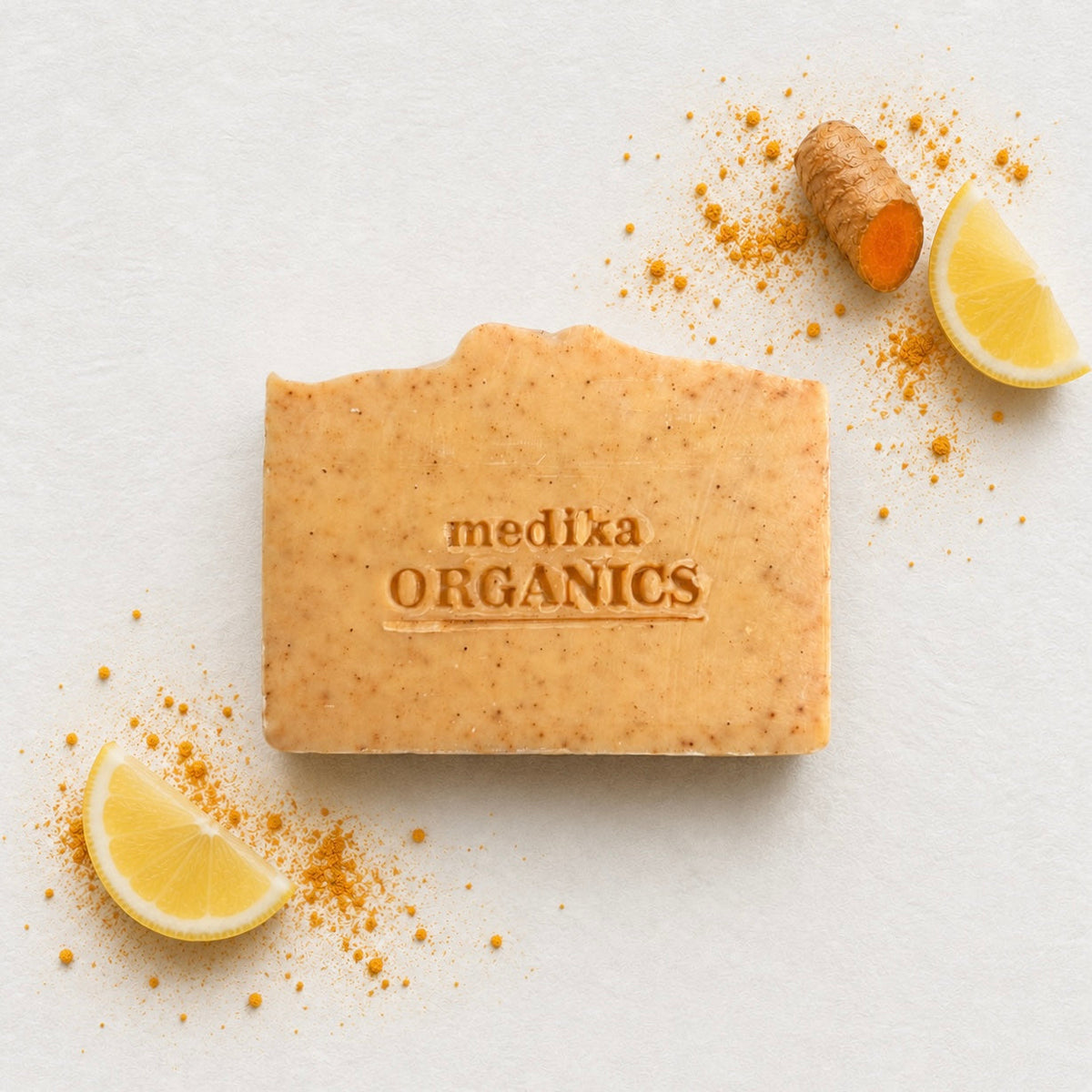
Turmeric soap has become one of the more searched skincare products in recent years, with many listings on marketplaces such as Etsy and major retailers promising brighter skin, cleared pores, and a glowing complexion. But very few of those listings explain whether the ingredient actually works in a rinse-off format, or why the formulation matters just as much as the turmeric itself.
Here at Medika Organics, we make our turmeric bar the same way we approach every product in our range: with organic ingredients and full label transparency. That gives us a practical vantage point for this kind of article. What follows is an honest, evidence-based breakdown covering the science behind turmeric's skin benefits, which skin types are the best candidates, how to read an ingredient list, how to use a turmeric cleansing bar safely, and where to find a quality option in Australia.
What turmeric actually does for your skin
Turmeric's active compound is curcumin, a polyphenol with documented anti-inflammatory, antioxidant, and antimicrobial properties in laboratory conditions. In a skin context, anti-inflammatory means curcumin may calm the chemical signalling pathways that make acne spots red, swollen, and slow to heal. It also shows a reduction in the appearance of reactive, irritated skin over time. The evidence is promising, but it's still early.
Brightening and antioxidant activity
Curcumin shows potential as a melanin-production inhibitor and free-radical neutraliser, which is why turmeric is commonly associated with a brighter, more even complexion. This is particularly relevant for post-blemish marks, where reducing ongoing inflammation and oxidative stress may support more even skin recovery. The key limitation for soap is contact time: a rinse-off product stays on your skin for under two minutes, which significantly limits how much curcumin is actually absorbed compared to a leave-on serum or mask.
Which skin types benefit most from a turmeric cleansing bar
Acne-prone and congested skin
Acne-prone skin is one of the stronger candidates for an organic turmeric soap. Curcumin's antimicrobial and anti-inflammatory properties target two of acne's main biological drivers: surface bacterial load and inflammatory response. Used as a daily cleanser, a well-formulated bar can help reduce surface bacteria and calm inflammation in mild cases, however it should not replace medicated treatments for moderate-to-severe acne. Cystic or hormonal acne has deeper drivers that a cleanser alone won't address, and those cases need clinical treatment.
Dull or uneven-toned skin
If your main concern is dullness or an uneven complexion, turmeric's antioxidant activity combined with the physical cleansing effect of a well-made bar can support a more luminous appearance over consistent use. Think of it as a daily maintenance step, not a corrective treatment, and expect gradual rather than dramatic results.
Sensitive or reactive skin
Not all sensitive skin will tolerate a "turmeric soap", particularly bars that include turmeric essential oil or synthetic fragrance. The turmeric itself is rarely the problem; it's usually the other ingredients packed around it. Always patch test before applying any new product to your face.
How a cold-process turmeric soap is made, and why the method matters
What cold-process soapmaking actually involves
Cold-process soap is made by combining oils and butters with a lye solution. The mixture saponifies at low temperature and then cures for several weeks. What the "cold-process method" does reliably do, is retain the natural glycerin that forms during saponification, something commercial soaps typically strip out. It also avoids the high-heat damage that affects other ingredients in the base formulation.
Many mass-market bars have added surfactants, fragrances, or dyes and may not retain natural glycerin. For a turmeric-infused soap, the integrity of the base formulation matters as much as the turmeric itself.
Turmeric powder, extract, or essential oil: what's actually in your bar
Understanding the form of turmeric in your bar is more useful than the word "turmeric" on the front label alone. Each form behaves differently in a formulation and carries a different risk profile for sensitive skin.
- Turmeric powder adds colour and curcuminoids but can feel gritty, settle unevenly through the bar, and transfer pigment to skin more readily than refined forms.
- Turmeric essential oil contributes volatile aromatic compounds and scent. It carries a higher sensitisation risk, particularly for fragrance-reactive or eczema-prone skin.
How Medika Organics makes its turmeric bar
Medika Organics turmeric soap bar is made in small batches using the cold-process method, with a base of organic oils and butters chosen for their skin compatibility. We use organic botanical turmeric rather than synthetic pigment, and publish a full ingredient list for every product, a meaningful commitment when formulating for people with reactive or sensitive skin.
What to look for on the ingredient list, and what to skip
Ingredients that work well alongside turmeric
Glycerin is one of the most useful supporting ingredients in any cleansing bar; it draws moisture to the skin and helps buffer the cleansing process. Lighter emollient oils such as olive complement turmeric well and sit lower on the comedogenic scale compared to heavier oil options. Shea butter also works well for dry or combination skin. The label "non-comedogenic" is a useful signal, but individual responses vary and it's not a guarantee.
How to use turmeric soap without staining or causing a reaction
Getting the most from each wash and keeping your towels clean
Staining is a real concern with turmeric bars, but it's manageable with the right technique. Pat dry with a dark or older towel; white towels and washcloths are not a good pairing with a turmeric soap bar. Any faint yellow tint on skin often rinses away with the next cleanse.
Patch testing, frequency, and when to stop
Before using any new active ingredient on your face, patch testing is an essential first step. Apply a small amount behind your ear or on your inner forearm, wait 24 to 48 hours, and monitor for redness, itching, or burning. If nothing develops, start using the bar every other day rather than daily, giving your skin time to adjust, particularly if it's dry or sensitive.
Where to buy a quality turmeric soap bar in Australia
Why Medika Organics is worth trying first
When choosing a turmeric soap bar in Australia, the criteria that matter are transparent ingredient labelling, cold-process manufacturing, organic ingredient sourcing, and honest sensory descriptions. Medika Organics addresses each of these points: full ingredient lists are published for every product, the cold-process method is used consistently across the range, and small-batch production means each bar receives a level of attention that mass-manufactured alternatives typically don't match. You can explore the full range and purchase directly through the Medika Organics website, where ingredient information is available before you buy.
The honest bottom line on turmeric soap
A quality turmeric soap bar is a genuinely useful addition to a daily routine for the right skin types, provided it's made with care and the right formulation choices behind it. The most important decision-making factors are what form of turmeric is used, what the base formulation looks like, and whether the maker publishes a full ingredient list.
If you've been curious about organic turmeric soap but weren't sure where to start, Medika Organics' small-batch turmeric bar is a solid first choice, cold-process made from organically sourced turmeric powder, fully labelled, and built for real skin. Explore the current range on the Medika Organics website.


